North Strathclyde Bairns' Hoose
Scotland's first Bairns' Hoose, developed in partnership with Children 1st. Serving families in East Dunbartonshire, East Renfrewshire, Inverclyde and Renfrewshire.
Phase 1
Context & Development
Nov 2021 – Dec 2022
✓ Complete
Context & Development
Nov 2021 – Dec 2022
✓ Complete
Phase 2
Opening & Initial Operation
Aug 2023 – Apr 2024
✓ Complete
Opening & Initial Operation
Aug 2023 – Apr 2024
✓ Complete
Phase 3 — Current
Recovery & Advocacy Model
Oct 2025 – Sep 2026
● In progress
Recovery & Advocacy Model
Oct 2025 – Sep 2026
● In progress
In April 2020, Children 1st, Victim Support Scotland, Children England and the University of Edinburgh came together to develop Scotland’s first Bairns’ Hoose in North Strathclyde. This was the first time the model had been developed and tested within Scotland, and only the second service informed by the model within the UK. Led by Children 1st, this three-year demonstration project (2021-2024) was funded Postcode Dream Fund, which was raised entirely by players of People’s Postcode Lottery. North Strathclyde Bairns’ Hoose provides support for children (and their families) living in the North Strathclyde (East Dunbartonshire, East Renfrewshire, Inverclyde and Renfrewshire) area of Scotland. As part of the partnership agreement, the University of Edinburgh agreed to carry out the evaluation of the project.
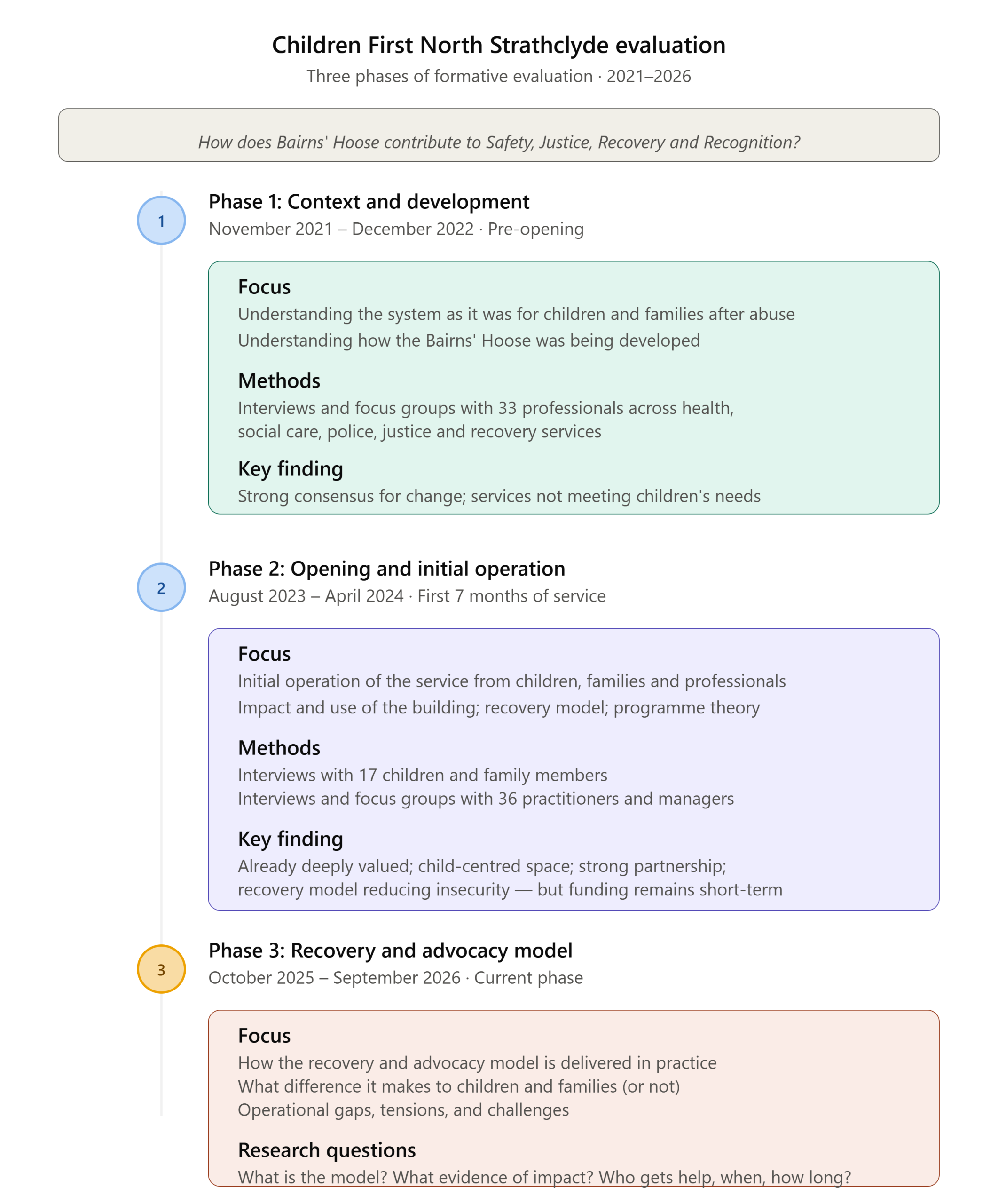
The formative evaluation has had two distinct phases and has been was framed by the overarching question of:
‘How does the Children 1st/ North Strathclyde Bairns’ Hoose contribute to the Safety, Justice, Recovery and Recognition of children (and their families) who use the service?’
Phase One was undertaken between November 2021 and December 2022, prior to the opening of the North Strathclyde Bairns’ Hoose. This phase focused on two key areas:
understanding the context children and families’ current experiences of services in North Strathclyde after abuse and maltreatment (the system as is), and
understanding the processes through which the Bairns’ Hoose is developing.
Phase One findings can be found in North Strathclyde Bairns Hoose Evaluation Phase One Report.
Phase Two of the formative evaluation covers the first months of the opening of the service from August 2023 – April 2024, and provides learning on the initial operation of the service from different perspectives including children and young people, family members and professionals.
Phase Two findings can be found in The Story So Far: North Strathclyde Bairns Hoose Phase Two Evaluation Report (2024)
A learning summary about the first year of the North Strathclyde Bairns Hoose Story So Far (accessible version) published March 2025.
Phase Three (October 2025- September 2026)
Building on the learning from previous evaluation work with Children First in North Strathclyde this third phase of the Bairns Hoose evaluation will focus on the Children First Bairns’ Hoose Recovery and Advocacy Model.
The aim of the project will be to:
Describe and clarify the ways in which the Children First recovery and advocacy model is delivered to children affected by abuse and their families in North Strathclyde; and the ways it hopes to influence change.
Position the model within broader understandings of recovery work with children affected by abuse and harm in Scotland, the UK and internationally.
Capture and analyse a) children and families own testimony about what difference the model makes to them (or not) and b) existing Children First (and potentially wider North Strathclyde) data about changes associated with the model.
Identify operational gaps, tensions or challenges within the current model and any potential solutions.
Key research questions are:
What is the current Children First Recovery and Advocacy Model? How is the model situated within current understandings of recovery and advocacy held by children, family members and professionals, and within literature (grey and academic).
What evidence is there that the Children First Recovery and Advocacy Model make a difference to those people supported by it? And if so, how and in what ways?
How are decisions regarding support and advocacy for children made in the current model? Who gets help, when and for how long? What are the limitations / challenges of the current model and how might these be mitigated?
The formative evaluation has had two distinct phases and has been was framed by the overarching question of:
‘How does the Children 1st/ North Strathclyde Bairns’ Hoose contribute to the Safety, Justice, Recovery and Recognition of children (and their families) who use the service?’
Phase One was undertaken between November 2021 and December 2022, prior to the opening of the North Strathclyde Bairns’ Hoose. This phase focused on two key areas:
understanding the context children and families’ current experiences of services in North Strathclyde after abuse and maltreatment (the system as is), and
understanding the processes through which the Bairns’ Hoose is developing.
Phase One findings can be found in North Strathclyde Bairns Hoose Evaluation Phase One Report.
Phase Two of the formative evaluation covers the first months of the opening of the service from August 2023 – April 2024, and provides learning on the initial operation of the service from different perspectives including children and young people, family members and professionals.
Phase Two findings can be found in The Story So Far: North Strathclyde Bairns Hoose Phase Two Evaluation Report (2024)
A learning summary about the first year of the North Strathclyde Bairns Hoose Story So Far (accessible version) published March 2025.
Phase Three (October 2025- September 2026)
Building on the learning from previous evaluation work with Children First in North Strathclyde this third phase of the Bairns Hoose evaluation will focus on the Children First Bairns’ Hoose Recovery and Advocacy Model.
The aim of the project will be to:
Describe and clarify the ways in which the Children First recovery and advocacy model is delivered to children affected by abuse and their families in North Strathclyde; and the ways it hopes to influence change.
Position the model within broader understandings of recovery work with children affected by abuse and harm in Scotland, the UK and internationally.
Capture and analyse a) children and families own testimony about what difference the model makes to them (or not) and b) existing Children First (and potentially wider North Strathclyde) data about changes associated with the model.
Identify operational gaps, tensions or challenges within the current model and any potential solutions.
Key research questions are:
What is the current Children First Recovery and Advocacy Model? How is the model situated within current understandings of recovery and advocacy held by children, family members and professionals, and within literature (grey and academic).
What evidence is there that the Children First Recovery and Advocacy Model make a difference to those people supported by it? And if so, how and in what ways?
How are decisions regarding support and advocacy for children made in the current model? Who gets help, when and for how long? What are the limitations / challenges of the current model and how might these be mitigated?